

UNESCO Participation Programme 2024–2025
Project Title : Saving Alkap, an Intangible Cultural Heritage of Bangladesh
Implemented by : Shapla Gram Unnayan Sangstha
Supported by : Bangladesh National commission for UNESCO
Project Areas : Rajshahi, Naogaon, Chapainawabganj
Prepared by : Project Coordination Team, SGUS
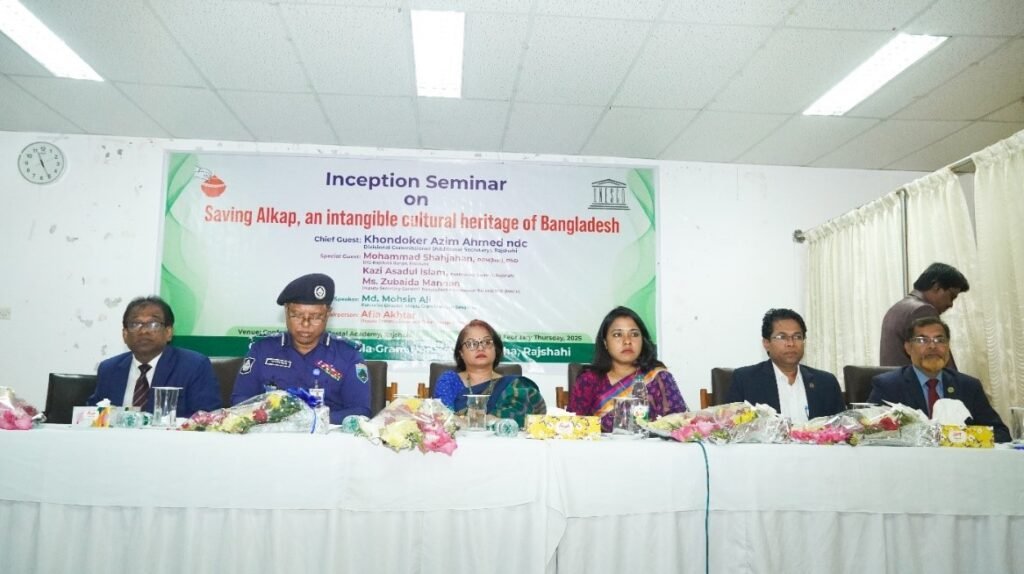
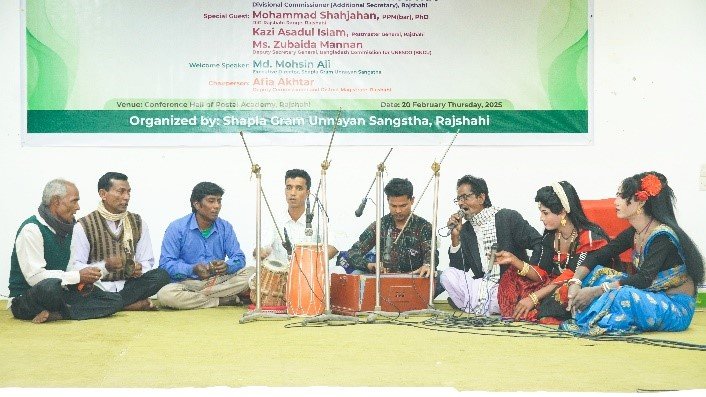
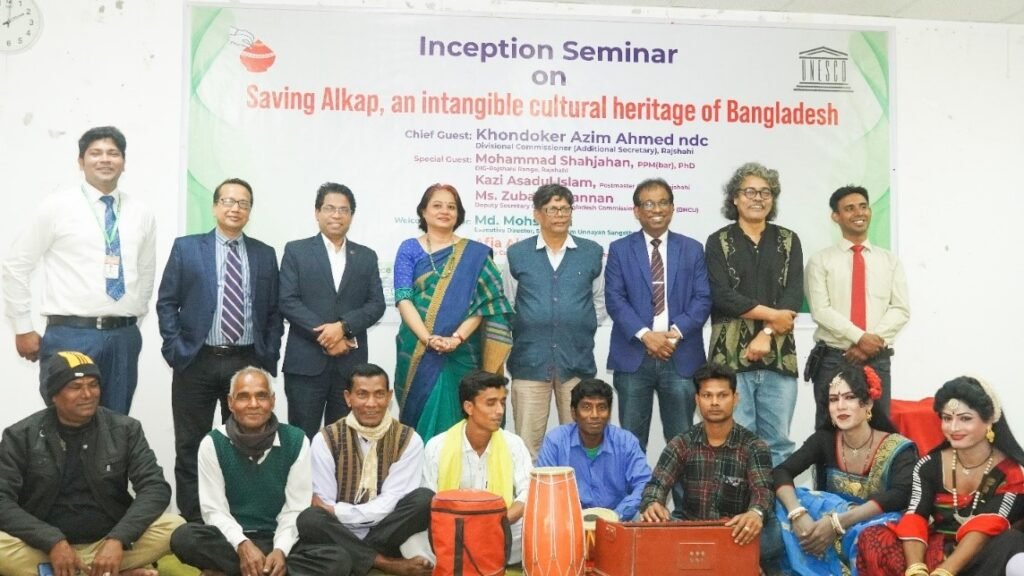
In a developing country like Bangladesh, non-governmental organizations play a vital role in driving both economic and cultural progress. Recognizing this, Shapla Gram Unnayan Sangstha (SGUS), a socio-culturally conscious NGO, has taken a bold step to preserve the nearly extinct traditional performance art form known as Alkap. This initiative has taken shape through the launch of the project titled “Saving Alkap, an Intangible Cultural Heritage of Bangladesh”, with generous support from the Bangladesh National Commission for UNESCO. As part of this initiative, an Inception Seminar was held on 20 February 2025 at the Rajshahi Postal Academy Auditorium, serving as the formal introduction of the project’s goals, planned activities, and vision for cultural revitalization.
Inception Seminar Report
Seminar Date : 20 February 2025
Venue : Rajshahi Postal Academy Auditorium
Time : 11:00 AM
The event was honored by a distinguished group of guests. The Chief Guest, Khandakar Azim Ahmed NDC, Divisional Commissioner (Additional Secretary), Rajshahi, was represented by Tuktuk Talukder, ADC (Education & ICT), Rajshahi. Special Guests included Dr. Mohammad Shahjahan, PPM (Bar), PhD, DIG – Rajshahi Range, and Kazi Asadul Islam, Postmaster General, Rajshahi. From the Bangladesh National Commission for UNESCO, three officials were present: Ms. Zubaida Mannan (Deputy Secretary General), Mr. Md. Tajuddin (Senior Program Officer), and Mr. Sheikh Saiful Islam Shuvo (Program Officer). Additionally, esteemed cultural personalities and academics including Prof. Dr. Muhammad Alamgir and Prof. Dr. Arif Haidar from the Department of Theatre, University of Rajshahi, attended alongside Mr. Abul Kalam Azad, Rajshahi Correspondent for Prothom Alo and Dr. Abdullah Al Firoz, Deputy Director of the Department of Social Services. Members of various Alkap teams, including their leaders (sarkars), as well as representatives from print, electronic, and social media, and project staff and researchers also graced the seminar with their presence.
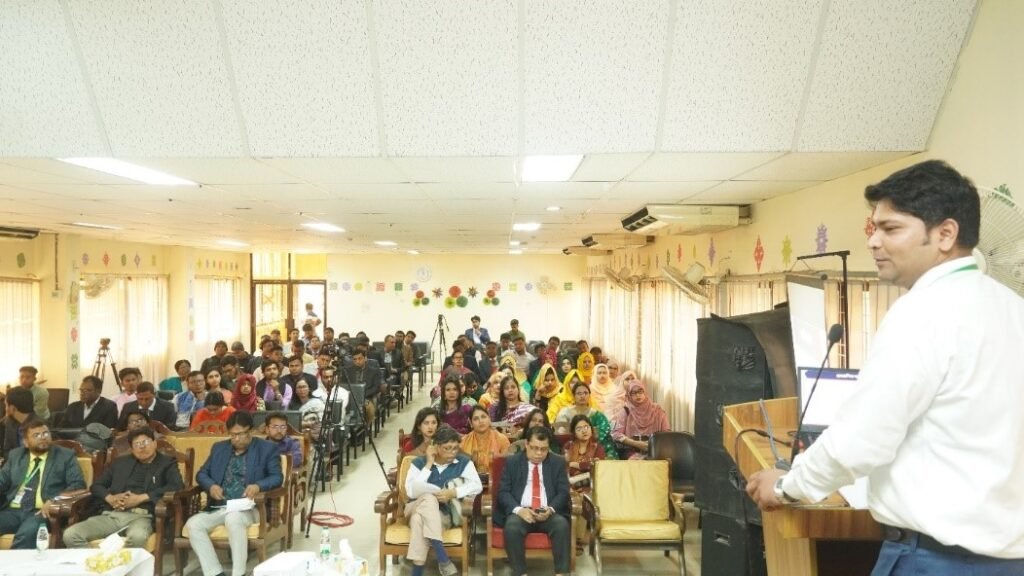
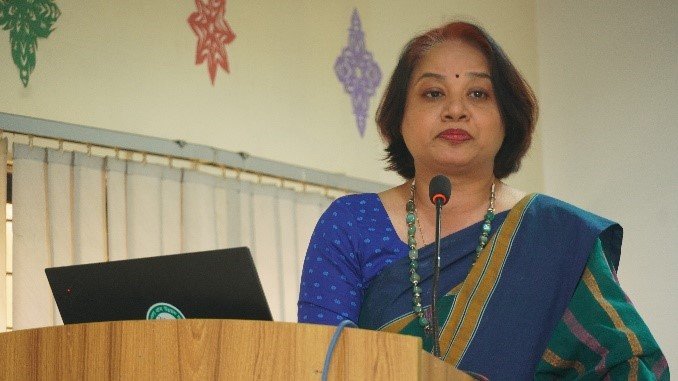
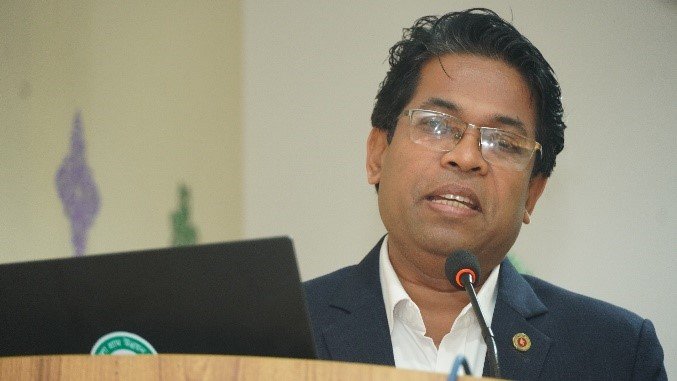
The program commenced with the recitation from the Holy Quran and verses from the Gita, reflecting a spirit of inclusivity and cultural harmony. The welcome address was delivered by Mr. Md. Mohsin Ali, Executive Director of SGUS, who underscored the urgent need to protect Alkap as a cultural identity and expressed gratitude to UNESCO for supporting the initiative. Following this, a detailed multimedia presentation was given by Dr. Md. Imrul Asad, Information & Research Officer of SGUS. His presentation provided a comprehensive overview of Alkap, the project’s structure and objectives, anticipated outcomes, and a breakdown of key activities such as baseline surveys, training workshops, educational material development, and community engagement programs. He emphasized the project’s dedication to inclusion, gender balance, sustainability, and the long-term goal of achieving international recognition for Alkap as an intangible cultural heritage.
An open discussion followed, during which various participants contributed valuable insights. Dr. Abdullah Al Firoz recommended expanding the number of selected artists beyond the proposed 300 and emphasized the need for separate workshops specifically designed for the team leaders or “Sarkars.” Mr. Abul Kalam Azad spoke on the importance of reconnecting Alkap with rural communities rather than limiting it to urban and institutional contexts. He also raised the need to
 |
 |
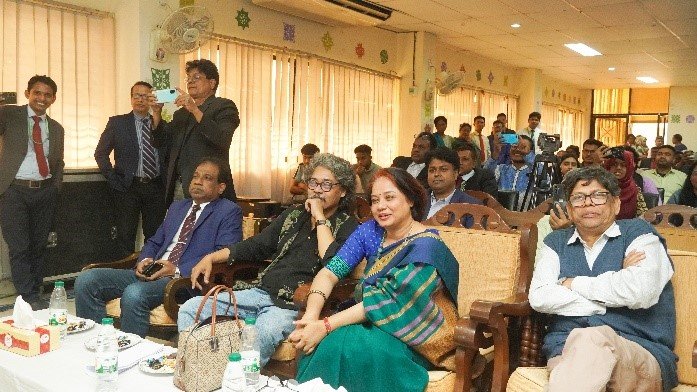 |
bridge the often-unspoken divide between cultural expression and religious sensibilities. Mr. Monowar Islam Bakul highlighted the perceived vulgarity in past Alkap performances and stressed the importance of ethical reform and performer education. On a different note, Prof. Dr. Muhammad Alamgir articulated that Alkap should not be seen merely as entertainment but as a platform for education and social reflection. He argued that what some consider “vulgarity” may in fact be a loss of artistic expression, and advocated for reviving Alkap’s aesthetic depth. A sarkar from one of the Alkap teams attributed the art form’s decline to religious extremism and administrative neglect and stressed the need for publicity and grassroots support to rekindle interest in this heritage.
 |
 |
From this seminar, several key outcomes emerged. Stakeholders were made well aware of the project’s framework and future course of action. The feedback from academics, cultural practitioners, and experts provided invaluable direction for refinement and implementation. The presence and participation of media and local government officials indicated strong support for the project’s cultural and educational ambitions. Most significantly, the event created a rare and inclusive platform for dialogue and collective reflection on the role of Alkap in contemporary society.
Noteworthy observations included a consensus that Alkap holds inherent educational and social value beyond its entertainment appeal. The importance of addressing cultural and religious stigmas associated with traditional folk performance was widely acknowledged. Participants also recognized the urgent need for comprehensive documentation, ethical performance development, and increased engagement with rural communities to ensure the long-term survival of the art form.
In light of these reflections, several recommendations were made. These included increasing outreach to marginalized and younger demographics, organizing follow-up workshops and consultations at the district level, fostering partnerships with academic and cultural institutions, and producing educational and artistic materials that are both respectful and effective in promoting social change.
the Inception Seminar for Saving Alkap successfully generated awareness, stimulated stakeholder engagement, and laid a strong foundation for the strategic and inclusive implementation of the project. The event demonstrated that with shared vision, institutional support and creative collaboration, it is possible to restore the dignity and relevance of one of Bangladesh’s oldest and most expressive cultural traditions.
Baseline Survey Report
Survey Period: November 2024 – February 2025
Survey Area: Rajshahi, Naogaon, and Chapainawabganj Districts
Report Prepared by: Information & Research Team, SGUS
Date of Submission: February 2025
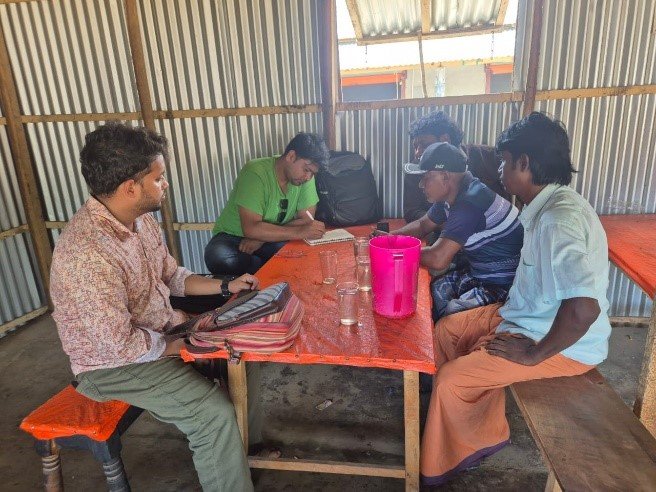
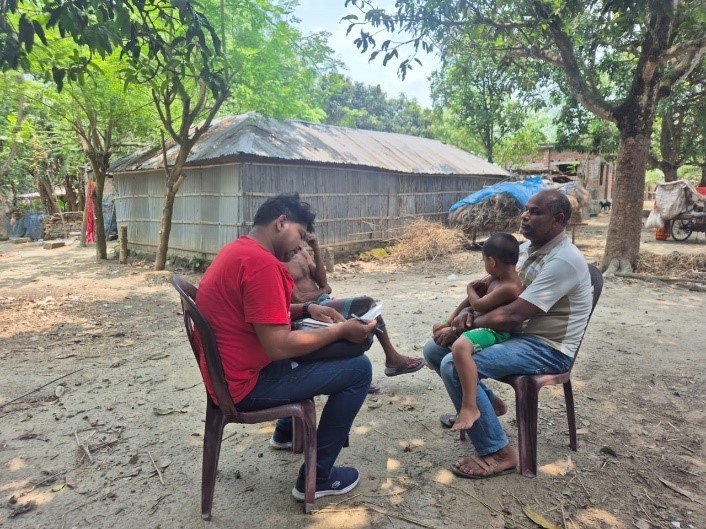
The Saving Alkap project has been initiated to identify, document, and revitalize the traditional performing art of Alkap, which is at risk of extinction in the northern districts of Bangladesh. As part of the project’s inception phase, a baseline survey was conducted across Rajshahi, Naogaon, and Chapainawabganj to gain a comprehensive understanding of the current status of Alkap practitioners, their performance patterns, geographical distribution, and the socio-cultural challenges they face. This survey served as the foundation for designing effective interventions to preserve this intangible cultural heritage.
The primary purpose of the baseline survey was to locate active Alkap teams and performers, assess their socio-economic conditions, analyze the frequency and nature of their performances, and prepare a detailed cultural map. The survey also aimed to create a functional database that could be used for training, capacity-building and community engagement initiatives throughout the project lifecycle.
 |
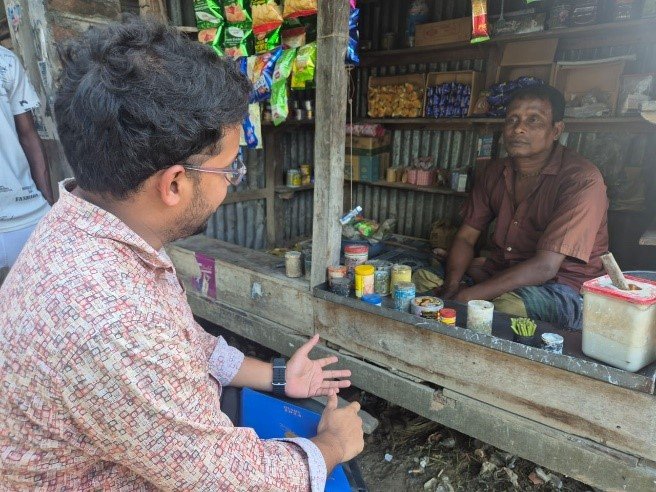 |
The survey was conducted over a span of four months, from November 2024 to February 2025. A specialized team consisting of one cultural experts, one local researchers, and two research assistants (who were also scholarship holders under this project) carried out the data collection. They employed a variety of qualitative and quantitative tools including structured questionnaires, in-depth interviews, direct observation and focus group discussions. Altogether, 20 active Alkap teams and 248 individual performers were surveyed. Name of the participants of those teams given below:
| Serial | Name | Role | Upazila | District |
| 1. | Abdur Rahim | Actor | Paba | Rajshahi |
| 2. | Abul Kalam Azad | Actor | Paba | Rajshahi |
| 3. | Kartik Ch. Hawladar | Actor | Paba | Rajshahi |
| 4. | Bishu Mondal | Singer | Paba | Rajshahi |
| 5. | Shoriful Islam | Singer | Paba | Rajshahi |
| 6. | Samad Sarkar | Singer | Paba | Rajshahi |
| 7. | Ataur Rahman | Instrumentalist | Mohanpur | Rajshahi |
| 8. | Washim | Instrumentalist | Mohanpur | Rajshahi |
| 9. | Nur Islam | Instrumentalist | Mohanpur | Rajshahi |
| 10. | Monsur Rahman | Instrumentalist | Mohanpur | Rajshahi |
| 11. | Md. Ali Sarkar | Instrumentalist | Mohanpur | Rajshahi |
| 12. | Md. Selim | Instrumentalist | Mohanpur | Rajshahi |
| 13. | Hazrat Ali Master | Instrumentalist | Mohanpur | Rajshahi |
| 14. | Kahin Alam | Singer | Durgapur | Rajshahi |
| 15. | Md. Shahjahan | Team Leader | Durgapur | Rajshahi |
| 16. | Md. Mostafa | Instrumentalist | Durgapur | Rajshahi |
| 17. | Rofiq | Instrumentalist | Durgapur | Rajshahi |
| 18. | Shahin | Singer | Durgapur | Rajshahi |
| 19. | Sonjit | Actor | Durgapur | Rajshahi |
| 20. | Anil | Singer | Tanore | Rajshahi |
| 21. | Arshad | Singer | Tanore | Rajshahi |
| 22. | Altab Hossain | Actor | Tanore | Rajshahi |
| 23. | Koni Sarkar | Singer | Tanore | Rajshahi |
| 24. | Kashem | Actor | Tanore | Rajshahi |
| 25. | Kumari Shikha Rani | Actor | Tanore | Rajshahi |
| 26. | Khoybor | Instrumentalist | Tanore | Rajshahi |
| 27. | Jilip Alam (Dilip) | Singer | Tanore | Rajshahi |
| 28. | Noju | Instrumentalist | Tanore | Rajshahi |
| 29. | Nomir | Instrumentalist | Tanore | Rajshahi |
| 30. | Bipul | Singer | Tanore | Rajshahi |
| 31. | Binod | Singer | Tanore | Rajshahi |
| 32. | Brishti Ara Khatun | Instrumentalist | Tanore | Rajshahi |
| 33. | Badol | Instrumentalist | Tanore | Rajshahi |
| 34. | Monjur Alam | Instrumentalist | Tanore | Rajshahi |
| 35. | Md. Habibur Sarkar | Team Leader | Tanore | Rajshahi |
| 36. | Razzakul | Team Leader | Tanore | Rajshahi |
| 37. | Rupen | Instrumentalist | Tanore | Rajshahi |
| 38. | Shoshi Alam | Instrumentalist | Tanore | Rajshahi |
| 39. | Sobuj | Singer | Tanore | Rajshahi |
| 40. | Sohrab Sarkar | Actor | Tanore | Rajshahi |
| 41. | Sujon | Actor | Tanore | Rajshahi |
| 42. | Selim | Instrumentalist | Tanore | Rajshahi |
| 43. | Swapon | Instrumentalist | Tanore | Rajshahi |
| 44. | Himu Sarkar | Instrumentalist | Tanore | Rajshahi |
| 45. | Hridoy | Instrumentalist | Tanore | Rajshahi |
| 46. | Dulal | Instrumentalist | Tanore | Rajshahi |
| 47. | Ab. Azim | Actor | Chapai-Sadar | Chapainawabganj |
| 48. | Aktar Ali | Singer | Chapai-Sadar | Chapainawabganj |
| 49. | Azizul Haque | Singer | Chapai-Sadar | Chapainawabganj |
| 50. | Azizur Rahman | Singer | Chapai-Sadar | Chapainawabganj |
| 51. | Anam Ali | Instrumentalist | Chapai-Sadar | Chapainawabganj |
| 52. | Ohab Sarkar | Singer | Chapai-Sadar | Chapainawabganj |
| 53. | Kawsar Ali | Instrumentalist | Chapai-Sadar | Chapainawabganj |
| 54. | Kuramat Ali | Instrumentalist | Chapai-Sadar | Chapainawabganj |
| 55. | Jahangir Alam | Singer | Chapai-Sadar | Chapainawabganj |
| 56. | Nurul Huda | Actor | Chapai-Sadar | Chapainawabganj |
| 57. | Nipen Chandra Chowdhury | Team Leader | Chapai-Sadar | Chapainawabganj |
| 58. | Faruk Hossain | Actor | Chapai-Sadar | Chapainawabganj |
| 59. | Bazlur Rahman | Instrumentalist | Chapai-Sadar | Chapainawabganj |
| 60. | Badol | Singer | Chapai-Sadar | Chapainawabganj |
| 61. | Moni | Instrumentalist | Chapai-Sadar | Chapainawabganj |
| 62. | Monmoth Karmakar | Actor | Chapai-Sadar | Chapainawabganj |
| 63. | Masir Ali | Singer | Chapai-Sadar | Chapainawabganj |
| 64. | Mizan | Instrumentalist | Chapai-Sadar | Chapainawabganj |
| 65. | Mintu | Instrumentalist | Chapai-Sadar | Chapainawabganj |
| 66. | Mintu Sarkar | Instrumentalist | Chapai-Sadar | Chapainawabganj |
| 67. | Ranjit Karmakar | Instrumentalist | Chapai-Sadar | Chapainawabganj |
| 68. | Russel Ahmed | Actor | Chapai-Sadar | Chapainawabganj |
| 69. | Shafiqul Sarkar | Instrumentalist | Chapai-Sadar | Chapainawabganj |
| 70. | Shrimati Basanti Rani | Singer, Actor | Chapai-Sadar | Chapainawabganj |
| 71. | Shrimati Reli Rani | Actress | Chapai-Sadar | Chapainawabganj |
| 72. | Shri Krishna Chandra Ghosh | Actor | Chapai-Sadar | Chapainawabganj |
| 73. | Shri Joy Chandra | Instrumentalist | Chapai-Sadar | Chapainawabganj |
| 74. | Shri Doyal Chandra | Actor | Chapai-Sadar | Chapainawabganj |
| 75. | Shri Niranjan Chowdhury | Actor | Chapai-Sadar | Chapainawabganj |
| 76. | Shri Ratan Chowdhury | Singer | Chapai-Sadar | Chapainawabganj |
| 77. | Shri Sonjoy Sarkar | Sarkar (Master) | Chapai-Sadar | Chapainawabganj |
| 78. | Shri Surabe Chandra Ghosh | Instrumentalist | Chapai-Sadar | Chapainawabganj |
| 79. | Sontu Das | Instrumentalist | Chapai-Sadar | Chapainawabganj |
| 80. | Sonjib Ghosh | Actor | Chapai-Sadar | Chapainawabganj |
| 81. | Saidul Sarkar | Singer | Chapai-Sadar | Chapainawabganj |
| 82. | Asadul | Instrumentalist | Shibganj | Chapainawabganj |
| 83. | Anarul Sarkar | Sarkar (Master) | Shibganj | Chapainawabganj |
| 84. | Arman Ali | Sarkar (Master) | Shibganj | Chapainawabganj |
| 85. | Alamgir | Instrumentalist | Shibganj | Chapainawabganj |
| 86. | Israil | Instrumentalist | Shibganj | Chapainawabganj |
| 87. | Enamul Haque | Instrumentalist | Shibganj | Chapainawabganj |
| 88. | Kobir Sarkar | Sarkar (Master) | Shibganj | Chapainawabganj |
| 89. | Kannu Babu | Instrumentalist | Shibganj | Chapainawabganj |
| 90. | Kalu | Instrumentalist | Shibganj | Chapainawabganj |
| 91. | Gobindo | Joker | Shibganj | Chapainawabganj |
| 92. | Jenarul | Instrumentalist | Shibganj | Chapainawabganj |
| 93. | Jibon | Dancer | Shibganj | Chapainawabganj |
| 94. | Taiyabur Rahman | Dancer | Shibganj | Chapainawabganj |
| 95. | Towfiqul | Instrumentalist | Shibganj | Chapainawabganj |
| 96. | Naoshad Ali | Patiwari | Shibganj | Chapainawabganj |
| 97. | Noyon | Instrumentalist | Shibganj | Chapainawabganj |
| 98. | Farhad | Dancer | Shibganj | Chapainawabganj |
| 99. | Bhonjon | Instrumentalist | Shibganj | Chapainawabganj |
| 100. | Biren | Instrumentalist | Shibganj | Chapainawabganj |
| 101. | Monglu Sarkar | Sarkar | Shibganj | Chapainawabganj |
| 102. | Mahidur Rahman | Instrumentalist | Shibganj | Chapainawabganj |
| 103. | Mamun Ali | Singer | Shibganj | Chapainawabganj |
| 104. | Roni | Instrumentalist | Shibganj | Chapainawabganj |
| 105. | Shahidul | Dancer | Shibganj | Chapainawabganj |
| 106. | Sonjoy Sarkar | Sarkar | Shibganj | Chapainawabganj |
| 107. | Saidul | Actor | Shibganj | Chapainawabganj |
| 108. | Saheb Sarkar | Singer | Shibganj | Chapainawabganj |
| 109. | Sujon | Actor | Shibganj | Chapainawabganj |
| 110. | Sunil Ghosh | Actor | Shibganj | Chapainawabganj |
| 111. | Soheb Sarkar | Team Leader | Shibganj | Chapainawabganj |
| 112. | Sohel Rana | Instrumentalist | Shibganj | Chapainawabganj |
| 113. | Soleman Sarkar | Singer | Shibganj | Chapainawabganj |
| 114. | Soleman Sarkar | Sarkar | Shibganj | Chapainawabganj |
| 115. | Horen Babu | Dancer | Shibganj | Chapainawabganj |
| 116. | Aza Sarkar | Singer | Gomostapur | Chapainawabganj |
| 117. | Azahar | Actor | Gomostapur | Chapainawabganj |
| 118. | Towfiq | Singer | Gomostapur | Chapainawabganj |
| 119. | Jalim Sarkar | Instrumentalist | Gomostapur | Chapainawabganj |
| 120. | Jamal Sarkar | Instrumentalist | Gomostapur | Chapainawabganj |
| 121. | Malek Sarkar | Team Leader | Gomostapur | Chapainawabganj |
| 122. | Masud | Instrumentalist | Gomostapur | Chapainawabganj |
| 123. | Mizan | Instrumentalist | Gomostapur | Chapainawabganj |
| 124. | Md. Monirul Islam | Instrumentalist | Gomostapur | Chapainawabganj |
| 125. | Md. Jahangir | Actor | Gomostapur | Chapainawabganj |
| 126. | Rujel | Singer | Gomostapur | Chapainawabganj |
| 127. | Rudro | Instrumentalist | Gomostapur | Chapainawabganj |
| 128. | Shimul | Singer | Gomostapur | Chapainawabganj |
| 129. | Sonjib | Instrumentalist | Gomostapur | Chapainawabganj |
| 130. | Saidul Sarkar | Singer | Gomostapur | Chapainawabganj |
| 131. | Saddam (Salam) | Singer | Gomostapur | Chapainawabganj |
| 132. | Salam Sarkar | Instrumentalist | Gomostapur | Chapainawabganj |
| 133. | Subrata Kumar Pal | Instrumentalist | Gomostapur | Chapainawabganj |
| 134. | Sentu Sarkar | Instrumentalist | Gomostapur | Chapainawabganj |
| 135. | Abatar | Actor | Nachol | Chapainawabganj |
| 136. | Anwar Sarkar | Singer | Nachol | Chapainawabganj |
| 137. | Amin Karmakar | Instrumentalist | Nachol | Chapainawabganj |
| 138. | Ismail | Actor | Nachol | Chapainawabganj |
| 139. | Uttam Sarkar | Instrumentalist | Nachol | Chapainawabganj |
| 140. | Kobir Sarkar | Singer | Nachol | Chapainawabganj |
| 141. | Komol Mahato | Instrumentalist | Nachol | Chapainawabganj |
| 142. | Kalu | Instrumentalist | Nachol | Chapainawabganj |
| 143. | Khoka | Actor | Nachol | Chapainawabganj |
| 144. | Khoka | Instrumentalist | Nachol | Chapainawabganj |
| 145. | Khalek | Instrumentalist | Nachol | Chapainawabganj |
| 146. | Chondon Mahato | Instrumentalist | Nachol | Chapainawabganj |
| 147. | Jenarul | Singer | Nachol | Chapainawabganj |
| 148. | Jogesh | Actor | Nachol | Chapainawabganj |
| 149. | Taizul | Actor | Nachol | Chapainawabganj |
| 150. | Dhiren Sarkar | Other | Nachol | Chapainawabganj |
| 151. | Naimul Sarkar | Team Leader | Nachol | Chapainawabganj |
| 152. | Nibaran Sarkar | Instrumentalist | Nachol | Chapainawabganj |
| 153. | Pak | Actor | Nachol | Chapainawabganj |
| 154. | Putul Sarkar | Actor | Nachol | Chapainawabganj |
| 155. | Babul Singh | Instrumentalist | Nachol | Chapainawabganj |
| 156. | Badol | Actor | Nachol | Chapainawabganj |
| 157. | Bikol Mahali | Singer | Nachol | Chapainawabganj |
| 158. | Bimol | Actor | Nachol | Chapainawabganj |
| 159. | Bhikuram Mahato | Instrumentalist | Nachol | Chapainawabganj |
| 160. | Md. Mobarak | Instrumentalist | Nachol | Chapainawabganj |
| 161. | Mahbub Sarkar | Actor | Nachol | Chapainawabganj |
| 162. | Musa | Other | Nachol | Chapainawabganj |
| 163. | Muslim Sarkar | Actor | Nachol | Chapainawabganj |
| 164. | Milon | Instrumentalist | Nachol | Chapainawabganj |
| 165. | Rustom | Actor | Nachol | Chapainawabganj |
| 166. | Rudro | Actor | Nachol | Chapainawabganj |
| 167. | Shafiqul Sarkar | Actor | Nachol | Chapainawabganj |
| 168. | Sachin Mahato | Actor | Nachol | Chapainawabganj |
| 169. | Sonjoy Sarkar | Singer | Nachol | Chapainawabganj |
| 170. | Sahabul Sarkar | Singer | Nachol | Chapainawabganj |
| 171. | Sadikul | Instrumentalist | Nachol | Chapainawabganj |
| 172. | Sairul | Instrumentalist | Nachol | Chapainawabganj |
| 173. | Sohel Sarkar | Other | Nachol | Chapainawabganj |
| 174. | Shri Kanta Sarkar | Team Leader | Nachol | Chapainawabganj |
| 175. | Swadhin Sarkar | Team Leader | Nachol | Chapainawabganj |
| 176. | Swadhin Sarkar | Team Leader | Nachol | Chapainawabganj |
| 177. | Haripada Singh | Instrumentalist | Nachol | Chapainawabganj |
| 178. | Haripada Sarkar | Instrumentalist | Nachol | Chapainawabganj |
| 179. | Dilip Karmakar | Actor | Nachol | Chapainawabganj |
| 180. | Osim | Instrumentalist | Volahat | Chapainawabganj |
| 181. | Azad Ali | Singer | Volahat | Chapainawabganj |
| 182. | Azdul Haque (Ezdul) | Instrumentalist | Volahat | Chapainawabganj |
| 183. | Asadul | Instrumentalist | Volahat | Chapainawabganj |
| 184. | Arman Ali | Team Leader | Volahat | Chapainawabganj |
| 185. | Alim | Instrumentalist | Volahat | Chapainawabganj |
| 186. | Enamul Haque | Instrumentalist | Volahat | Chapainawabganj |
| 187. | Omar Sarkar | Actor | Volahat | Chapainawabganj |
| 188. | Kanu Babu | Instrumentalist | Volahat | Chapainawabganj |
| 189. | Kalu | Instrumentalist | Volahat | Chapainawabganj |
| 190. | Kalu Sarkar | Actor | Volahat | Chapainawabganj |
| 191. | Khalek Sarkar | Instrumentalist | Volahat | Chapainawabganj |
| 192. | Jubayer Sarkar | Actor | Volahat | Chapainawabganj |
| 193. | Jalim | Actor | Volahat | Chapainawabganj |
| 194. | Jamal Haque | Instrumentalist | Volahat | Chapainawabganj |
| 195. | Jibon | Actor | Volahat | Chapainawabganj |
| 196. | Topu Sarkar | Team Leader | Volahat | Chapainawabganj |
| 197. | Taiyabur Rahman | Actor | Volahat | Chapainawabganj |
| 198. | Doyal Babu | Actor | Volahat | Chapainawabganj |
| 199. | Naoshad Ali | Actor | Volahat | Chapainawabganj |
| 200. | Babu | Actor | Volahat | Chapainawabganj |
| 201. | Felu Sarkar | Team Leader | Volahat | Chapainawabganj |
| 202. | Felu Sarkar | Team Leader | Volahat | Chapainawabganj |
| 203. | Mondal Sarkar | Actor | Volahat | Chapainawabganj |
| 204. | Mahbub Sarkar | Instrumentalist | Volahat | Chapainawabganj |
| 205. | Miton | Actor | Volahat | Chapainawabganj |
| 206. | Mintu Sarkar | Instrumentalist | Volahat | Chapainawabganj |
| 207. | Md. Tajonur | Actor | Volahat | Chapainawabganj |
| 208. | Md. Naoshad Ali | Singer | Volahat | Chapainawabganj |
| 209. | Mobarak | Instrumentalist | Volahat | Chapainawabganj |
| 210. | Lutfor Sarkar | Instrumentalist | Volahat | Chapainawabganj |
| 211. | Lutfor Sarkar | Instrumentalist | Volahat | Chapainawabganj |
| 212. | Lutfor Sarkar | Team Leader | Volahat | Chapainawabganj |
| 213. | Shahidul Rahman | Instrumentalist | Volahat | Chapainawabganj |
| 214. | Shri Potol Chandra Roy | Instrumentalist | Volahat | Chapainawabganj |
| 215. | Shri Bibind | Instrumentalist | Volahat | Chapainawabganj |
| 216. | Shrimati Reli Rani | Actress | Volahat | Chapainawabganj |
| 217. | Sujon Ali | Actor | Volahat | Chapainawabganj |
| 218. | Soheli Rana | Instrumentalist | Volahat | Chapainawabganj |
| 219. | Haripodo | Singer | Volahat | Chapainawabganj |
| 220. | Horen Babu | Actor | Volahat | Chapainawabganj |
| 221. | Ripon | Actor | Volahat | Chapainawabganj |
| 222. | Ajay Saha | Joker | Niamatpur | Naogaon |
| 223. | Khoka Mahali | Instrumentalist | Niamatpur | Naogaon |
| 224. | Ron Sarkar | Actor | Niamatpur | Naogaon |
| 225. | Tarapodo Robidas | Dancer | Niamatpur | Naogaon |
| 226. | Dwijen Karmakar | Instrumentalist | Niamatpur | Naogaon |
| 227. | Nazrul Islam | Actor | Niamatpur | Naogaon |
| 228. | Nibaran Karmakar | Actor | Niamatpur | Naogaon |
| 229. | Bablu Singh | Instrumentalist | Niamatpur | Naogaon |
| 230. | Bipol Mahali | Instrumentalist | Niamatpur | Naogaon |
| 231. | Biplob Pahan | Dancer | Niamatpur | Naogaon |
| 232. | Monoranjan Chandra Barman | Actor | Niamatpur | Naogaon |
| 233. | Monmoth Karmakar | Instrumentalist | Niamatpur | Naogaon |
| 234. | Mobarak | Instrumentalist | Niamatpur | Naogaon |
| 235. | Ratan Mali | Dancer | Niamatpur | Naogaon |
| 236. | Sohit Karmakar | Dancer | Niamatpur | Naogaon |
| 237. | Shagor Robidas | Instrumentalist | Niamatpur | Naogaon |
| 238. | Sugren Chandra Barman | Instrumentalist | Niamatpur | Naogaon |
| 239. | Subrata Karmakar | Instrumentalist | Niamatpur | Naogaon |
| 240. | Suren Karmakar | Instrumentalist | Niamatpur | Naogaon |
| 241. | Shri Jiten Barman | Instrumentalist | Niamatpur | Naogaon |
| 242. | Shri Nabin Chandra Barman | Instrumentalist | Niamatpur | Naogaon |
| 243. | Shri Bidash Chandra Barman | Actor | Niamatpur | Naogaon |
| 244. | Shri Bhubon Chandra Barman | Actor | Niamatpur | Naogaon |
| 245. | Shri Lalit Karmakar | Instrumentalist | Niamatpur | Naogaon |
| 246. | Shri Reboti Doctor | Actor | Niamatpur | Naogaon |
| 247. | Shri Swapon Barman | Team Leader | Niamatpur | Naogaon |
| 248. | Haripada Singh | Instrumentalist | Niamatpur | Naogaon |
According to the findings, there are 20 active Alkap teams operating informally across the three districts. These teams, each comprising 10 to 20 members are unregistered and often function without any institutional support. Four teams were found in Rajshahi, two in Naogaon and another fourteen in Chapainawabganj.
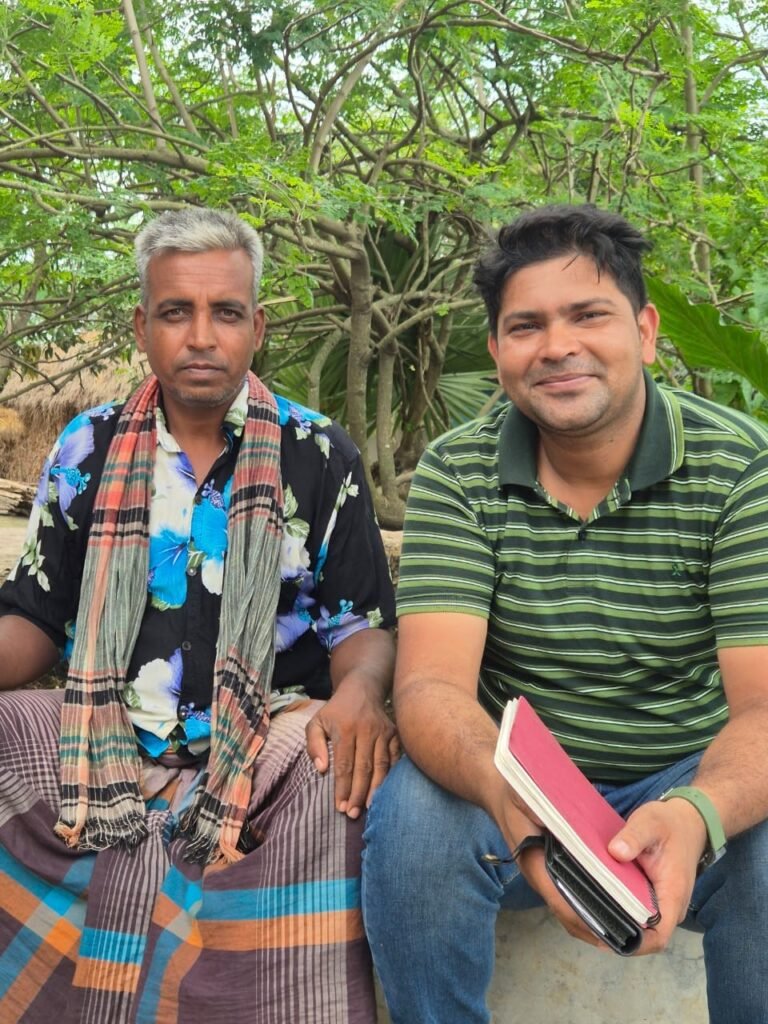 |
The socio-economic status of the performers remains precarious. Approximately 72% of the artists surveyed rely on Alkap as either a primary or secondary source of income. Many of them lack formal education or access to stable employment opportunities. Poverty, inadequate healthcare and social neglection characterize the daily realities of most practitioners. In terms of demographics, the survey revealed that 99% of performers are male and 1% are transgender, with the latter group being more visible in Chapainawabganj. The age distribution shows a clear dominance of middle-aged performers, between 25 and 55 years, while younger individuals under the age of 25 were found to be significantly underrepresented pointing to a generational discontinuity in the practice.
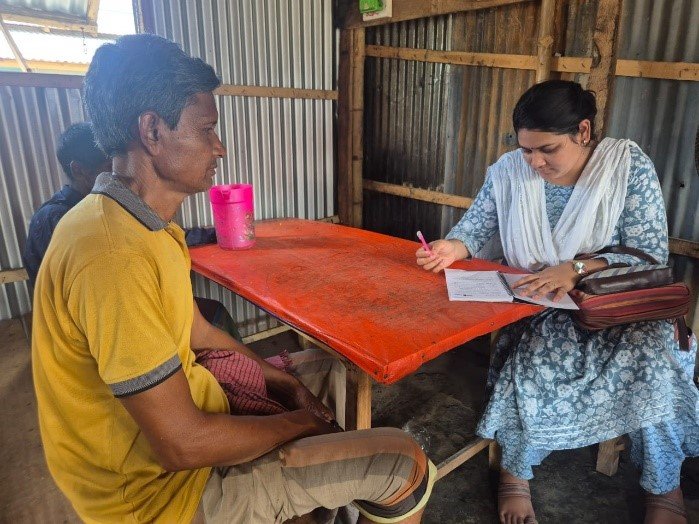
Performance trends also show a decline. Alkap performances now mostly occur during the Bengali calendar months of Falgun to Ashar, primarily at rural fairs, weddings, community festivals and private functions. However, each team now averages only five to eight performances annually, a sharp decrease compared to previous decades when performances were more frequent. Several factors contribute to this decline, including negative social perception, lack of financial and institutional support and diminishing interest among younger generations. The content of Alkap performances is sometimes viewed as vulgar by conservative audiences, further limiting its reach and acceptance.
 |
 |
Despite these challenges, the baseline survey also revealed several opportunities for revitalization. Participants expressed strong enthusiasm for receiving training, modernizing performance content and connecting with broader audiences. There is potential for increasing youth engagement by introducing Alkap to the school and community programs. Moreover, documentation of individual performer profiles and team histories could help in promoting Alkap to academic and cultural institutions. Greater inclusivity— reworking thematic content to address pressing social issues while maintaining the traditional aesthetic of Alkap and advocating for district-level recognition and financial support for Alkap artists.
The baseline survey ultimately produced several tangible outputs like a verified list of 248 active Alkap practitioners, detailed district-wise team profiles, a preliminary map highlighting zones of cultural activity, also an archive of interviews and photographs for future research and promotion. A number of senior performers were also identified as potential trainers, capable of mentoring younger artists and leading future workshops under the project.
Overall, the survey successfully captured both the current vulnerabilities and the cultural vitality of Alkap as a traditional performance art. It provides a strategic foundation for the next phases of the project, including training module development and performance production. With coordinated action, community involvement and continued support from institutions like UNESCO, Alkap can be safeguarded and revived as a powerful medium for both cultural expression and social development.
Training & Workshop Report
Venue: Zila Shilpakala Academy, Chapainawabganj
Date: 31 May – 4 June 2025
As part of the ongoing `Saving Alkap’ project, a five-day intensive training and workshop session was conducted at Chapainawabganj with the aim of strengthening the artistic, vocal, and narrative skills of traditional Alkap performers. This initiative was designed to enable participants to deliver performances that are not only culturally rich but also socially relevant, in alignment with the broader goals of the project. The training emphasized the revival of traditional techniques, enhancement of storytelling and voice projection, promotion of gender inclusivity and preparation of artists to actively engage in community awareness activities focused on pressing social issues.
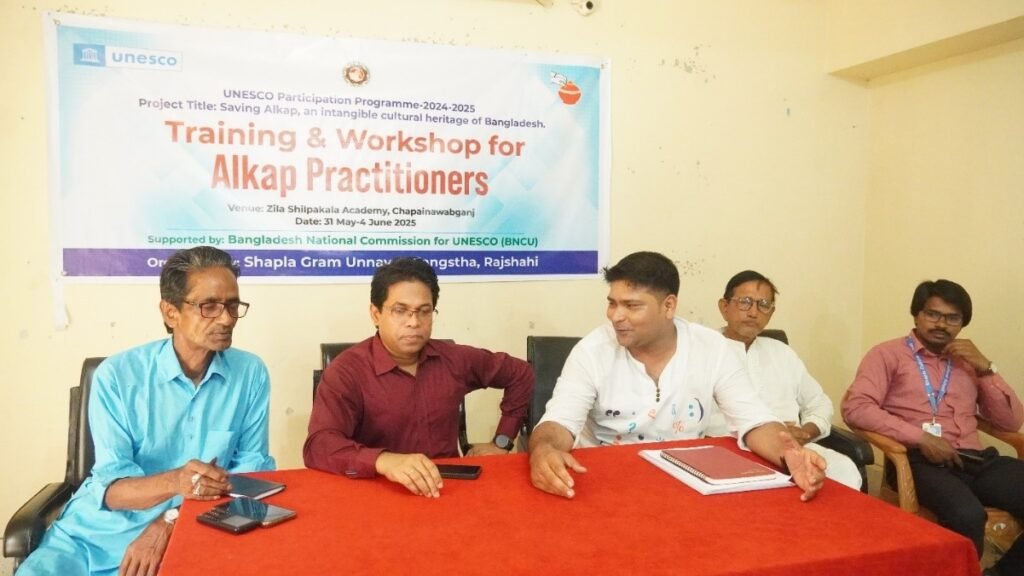 |
A total of twenty male artists took part in the training. Most of them are young and newly started practicing Alkap. These participants were selected from six different Alkap teams across various unions of the Chapainawabganj district, based on data gathered during the previously conducted baseline survey. The diversity of the participant reflected the project’s commitment to inclusion and representation of marginalized voices.
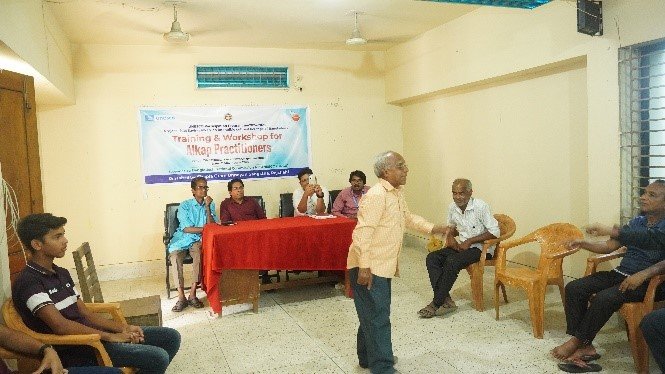
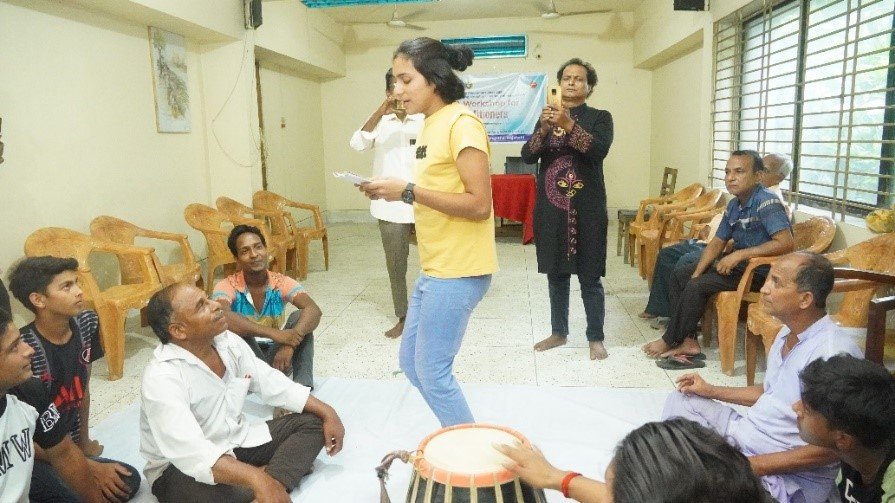
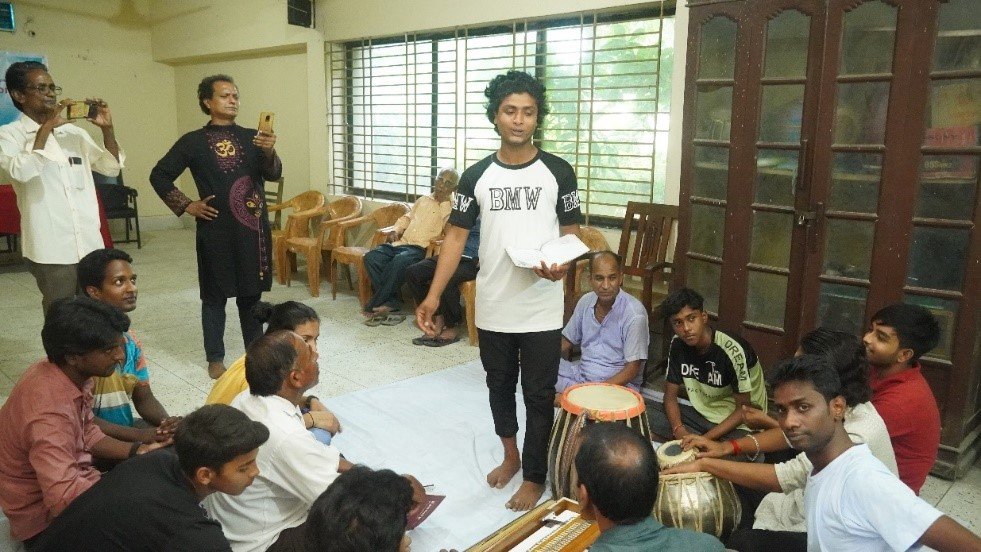
The training was facilitated by a team of experienced resource persons, including master Alkap performers with over three decades of performance history, theatre experts from Rajshahi University, cultural activists and community mobilizers. In addition, members of the project’s research and media coordination teams provided technical and logistical support throughout the sessions. The workshop was structured over five days with each day focused on a specific training module. On the first day, participants were introduced to the historical and cultural significance of Alkap as an intangible cultural heritage. The second day focused on voice training and vocal projection techniques, covering breath control, articulation and projection. The third day emphasized storytelling methods, encouraging participants to integrate social messages into their narratives. On the fourth day, movement training and stage dynamics were practiced through physical exercises aimed at improving body language, coordination, and presence. The final day involved mock performances where participants showcased what they had learned, followed by constructive feedback from trainers and peers.
 |
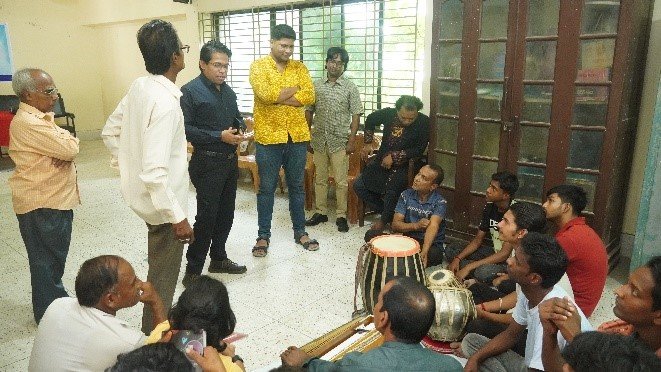 |
The workshop was marked by several significant highlights. The opening session drew attention from local cultural officials and media representatives, establishing the event’s importance in the community. One of the most engaging activities was a group discussion on how Alkap performances can be used to address issues such as child marriage, dowry, drug addiction and gender-based violence. Participants collaborated on new scripts that centered around themes like women’s empowerment, internet abuse, drug addiction and sexual harassment. The involvement of female and transgender artists added depth to these stories, as they brought forward their lived experiences and personal insights, enriching the performance process. The workshop culminated with a mini stage performance that was recorded for documentation and future reference.
 |
The outcomes of the training were overwhelmingly positive. Artists reported improved confidence and stronger stage presence. Their understanding of voice control, narrative structure and message-driven performance increased significantly. The workshop fostered a greater sense of collaboration among the various Alkap teams, who expressed enthusiasm about using their performances as tools for social awareness. Additionally, trainers identified six participants who showed exceptional potential to become future trainers or team leaders within their respective groups.
 |
Participants shared heartfelt feedback on their experience. Many of them acknowledged that they had never received this kind of structured training before and that the workshop gave them a new perspective on the purpose and impact of their art. A few noted that they now feel empowered to use Alkap not just as entertainment but as a medium for education and advocacy. The transgender participant expressed particular appreciation for the inclusive nature of the training, stating that their participation was met with respect and support, which was a significant and validating experience.
Despite its success, the workshop faced a few challenges. Some participants initially struggled to adapt to the structured and formal rehearsal format, which was new to many of them. The hot weather during the training days caused discomfort, especially during longer sessions. Additionally, there was limited access to a fully equipped rehearsal stage and proper sound equipment, which slightly hindered the flow of group activities.
Based on these experiences, several recommendations were put forward. It was suggested that future workshops include portable sound systems to aid in performance practice. Arranging follow-up sessions focused on script development and performance ethics was also proposed to intensify the learning process. Furthermore, the inclusion of digital skills training such as recording, archiving, and content sharing was recommended for team leaders to help preserve and promote their work. Finally, increased participation of marginalized performers, especially women and transgender individuals, should be prioritized in upcoming workshops to further strengthen the inclusive goals of the project.
Training & Workshop Report
Venue: Auditorium, Tanore Upazila Parishad, Rajshahi
Date: 3 – 7 July 2025
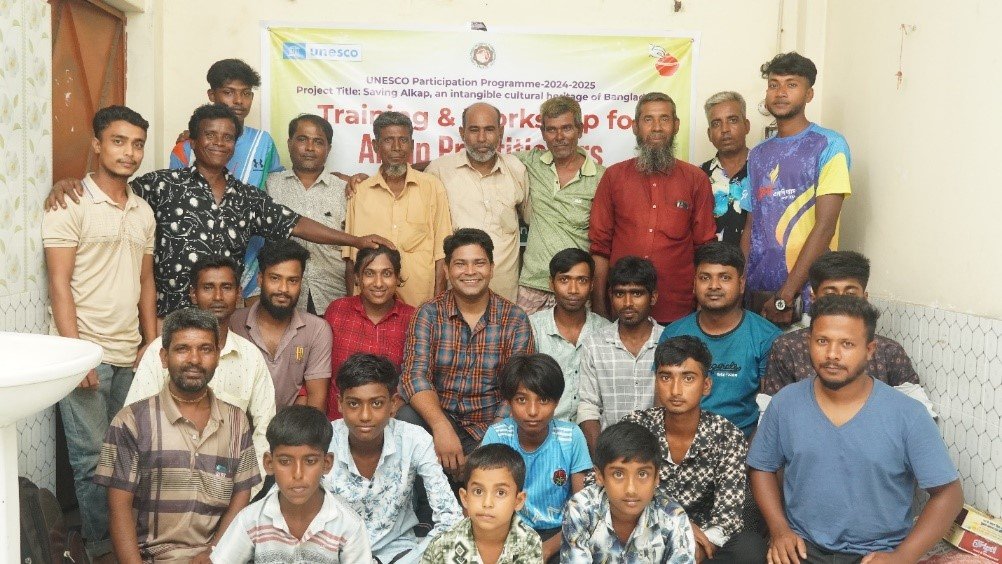 |
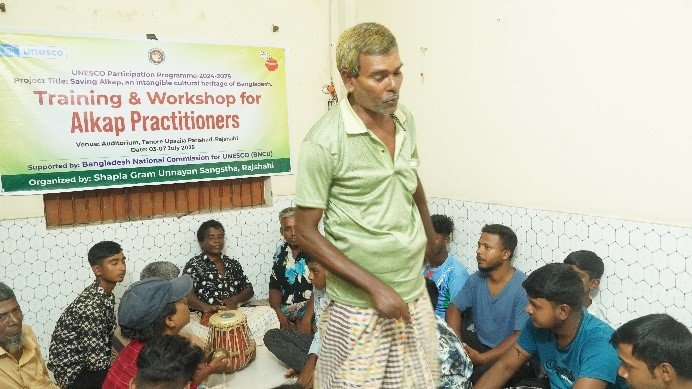
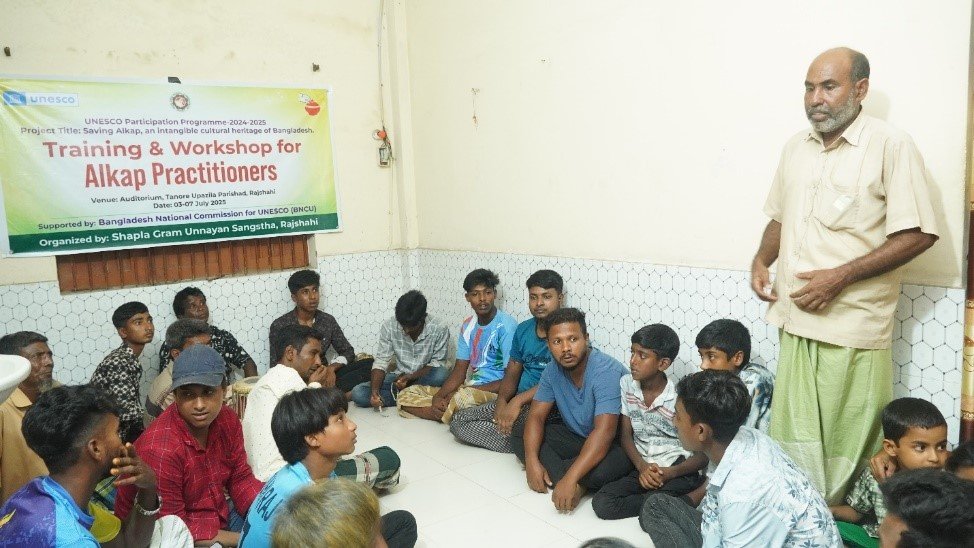
This workshop marked the Second round in a series of capacity-building initiatives under the Saving Alkap project. Its primary aim was to provide formal training to traditional Alkap artists in the Rajshahi region, equipping them with refined performance skills and enabling them to address socially relevant themes through their art. The sessions were also designed to foster deeper youth and community engagement in preserving Alkap as a vital component of Bangladesh’s intangible cultural heritage. Key focus areas of the workshop included enhancing vocal and performance techniques, developing storytelling, content based on contemporary social issues, promoting intergenerational learning and encouraging active participation from youth, women and marginalized artists.
A total of twenty individuals participated in the training, which included twelves adult male performers and eight youth participants aged between 10 and 18. These participants were drawn from three active Alkap teams based in Tanore and surrounding unions of Rajshahi district. Their selection was based on the findings of the baseline survey as well as recommendations from local team leaders, ensuring both experience and potential were considered in the process.
The
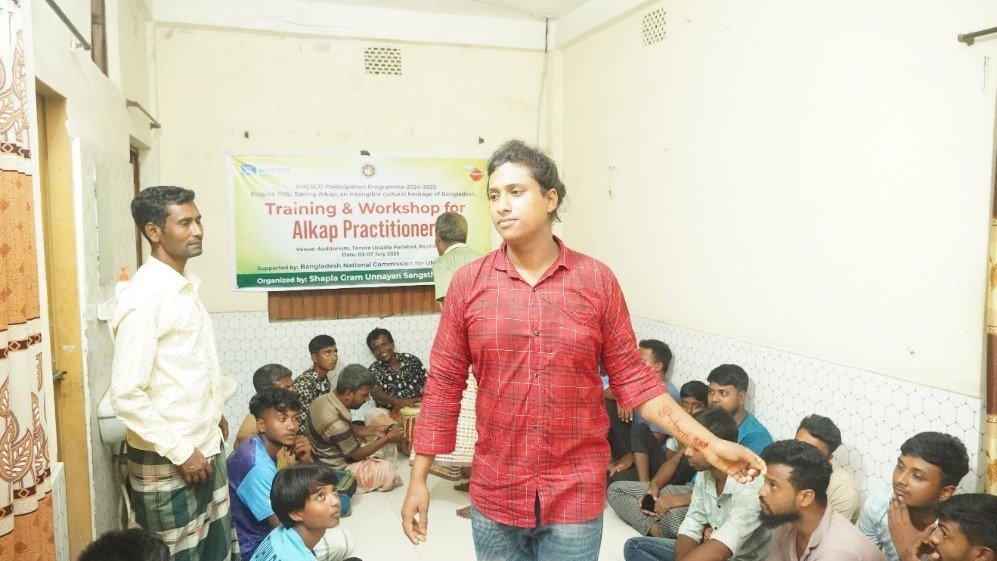 |
sessions were led by a well-rounded panel of resource persons that included senior Alkap artists with more than 25 years of performance experience, theatre experts from local cultural organizations based in Rajshahi and research and media professionals from Shapla Gram Unnayan Sangstha (SGUS). These trainers conducted technical modules, supervised rehearsals and offered individualized mentoring to support participant development throughout the five-day event.
The workshop followed a structured format, with each day dedicated to a specific focus area. The opening day served as an orientation session where participants engaged in icebreaking activities and the formation of group dynamics. The second day centered on vocal and rhythmic training, emphasizing breathing techniques, voice modulation and traditional beat practice. On the third day, attention shifted to script preparing and the development of social messages, where participants crafted narratives around issues such as dowry, drug addiction and unemployment. Day four focused on movement and stage coordination, training participants in body language and character-based movement. The final day featured group performances that were followed by a feedback session involving both trainers and peers.
 |
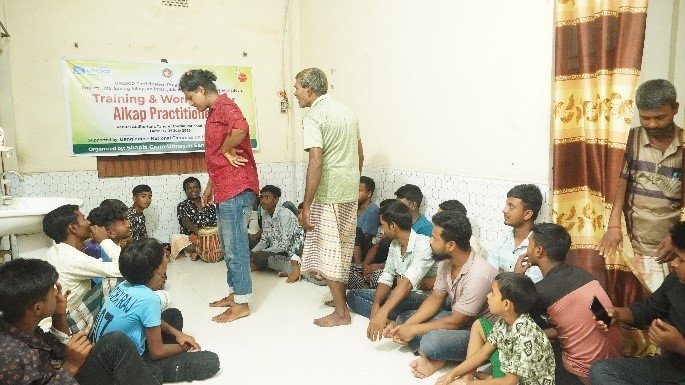 |
Several highlights emerged over the course of the workshop. One of the most impactful moments was a group discussion on why Alkap is losing relevance among younger generations, which sparked insightful exchanges between participants. Script development exercises led to the creation of new performance pieces focused on topics such as violence against women, juvenile gang and unemployment. Master trainers demonstrated traditional Alkap styles and offered in-depth coaching on rhythm and synchronization, especially targeting the youth participants. The concluding session on the final day showcased a series of mock performances that captured the participants’ learning and creativity and were documented for future use.
The training revealed several positive observations. Youth participants demonstrated a high level of enthusiasm and creativity, bringing new energy to a traditionally older art form. Veteran performers welcomed the inclusion of modern social issues in Alkap, recognizing the potential to connect with today’s audiences. The intergenerational interaction promoted mutual respect and mentorship, creating a collaborative learning environment. Notably, local government officials visited the workshop on the third day and expressed their support and interest in future Alkap-based events.
The outcomes of the workshop were both measurable and meaningful. Four new Alkap scripts incorporating social themes were developed. Five artists were identified by trainers as having the potential to serve as community trainers in future sessions. The youth participants, motivated by the workshop, expressed intent to continue practicing and performing Alkap in their communities. Overall, the event fostered a strong sense of cultural ownership and pride among all involved, reinforcing the importance of heritage preservation at the grassroots level.
Participant feedback was overwhelmingly positive. One remarked, ‘For the first time we got to know that Alkap can educate the society’, highlighting the new perspective gained from the experience. Another shared, We used to sing songs, but now we know how to tell a story’, emphasizing the importance of narrative structure. A third participant joyfully noted, `It felt so good that young and elderly practitioners worked and learned together’, reflecting the inclusive and harmonious environment of the workshop.
 |
Despite its successes, the workshop faced a few challenges. The hall used for group activities was somewhat limited in space, which occasionally restricted free movement and performance exercises. The absence of adequate sound equipment also made musical rehearsals difficult. Moreover, one day of the workshop was disrupted by rain, which particularly affected the movement-based outdoor activities.
Based on these experiences, several recommendations were proposed for future sessions. These include allocating a larger and better-ventilated space for rehearsals, providing basic sound equipment or musical kits to support rhythm and coordination exercises, and organizing follow-up workshops especially in rural and union-level areas to ensure continuity. Additionally, inter-district team exchanges were suggested to encourage learning and cultural sharing between different regions.
Training & Workshop Report
Venue: Baishakhi Community Center, Gangor Bazar, Niyamotpur, Naogaon.
Date: 09 – 13 August 2025
 |
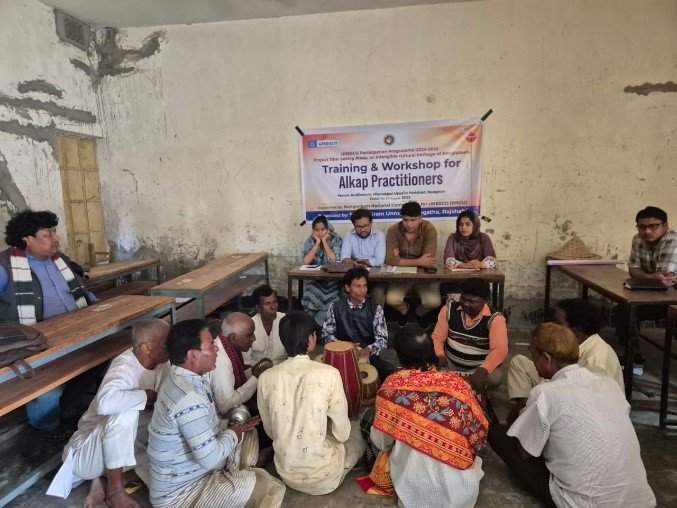 |
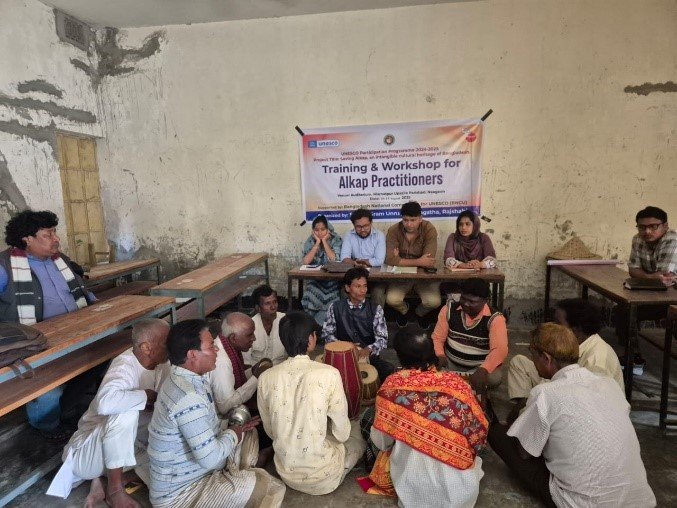
The third round of workshop held on August 9, 2025, at the Baishakhi Community Center, Gangor Bazar, Niyamotpur, Naogaon. The primary mission of this session was to address the decaying presence of Alkap, a multi-disciplinary folk performance native to the Rajshahi and West Bengal regions by bridging the gap between aging masters and the next generation of artists.
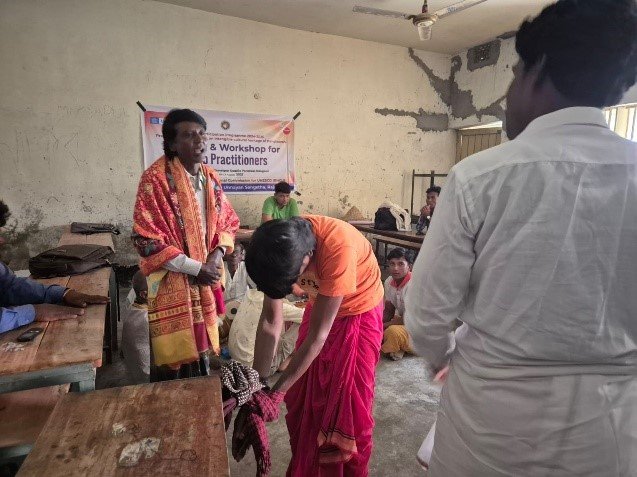
The workshop was specialized by its highly participatory theme, moving beyond theoretical lectures into immersive, hands-on practice. Senior practitioners, distinguished by their traditional attire led sessions on the floor, seated in traditional circles that encouraged peer-to-peer learning. Musical training was a core component with focused instruction on the rhythmic complexities of the Dhol and the melodic accompaniment of the Harmonium, both of which are essential to maintaining the authentic `Alkap rhythm’.
Beyond performance mechanics, the workshop facilitated deep-dive discussions on the socio-cultural challenges facing the art form. Coordinators and researchers worked with the practitioners to document oral scripts and improvised storytelling techniques that have historically been passed down without written records.
 |
 |
By formalizing this training within an institutional framework, it was aimed to provide Alkap with the “intangible heritage” status it needs to survive modern commercial pressures. The day concluded with a commitment to creating a sustainable network of practitioners in the Naogaon region, ensuring that this vibrant blend of dance, drama, and wit continues to resonate in the villages of Bangladesh.
Alkap Production-1
Venue: Zila Shilpakala Academy, Chapainawabganj
Date: 22 December 2025
The Alkap Production was successfully staged on Monday, 22 December 2025, at the Zila Shilpakala Academy auditorium in Chapainawabganj as a vital effort to rescue the traditional folk culture of `Alkap’ from the edge of extinction. This initiative was conducted under the UNESCO Participation Programme 2024-2025 framework, specifically through a project titled `Saving Alkap, an intangible cultural heritage of Bangladesh’. The primary goal of the program was to sustain the heritage of Alkap and bridge the gap between this ancient art form and the new generation, who are increasingly influenced by modern global culture.
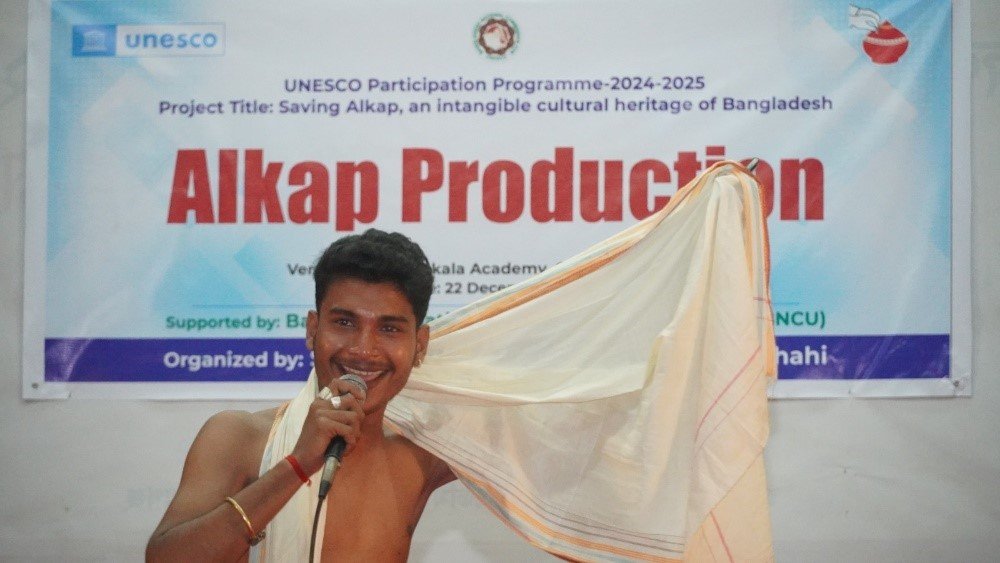
The performance itself was a collaborative masterpiece, featuring veteran local Alkap artists who mentored and performed alongside a group of talented young performers. Through skillful acting, traditional music and folklore, the production vividly portrayed rural lifestyles while using its signature humor and satire to address critical modern-day challenges.
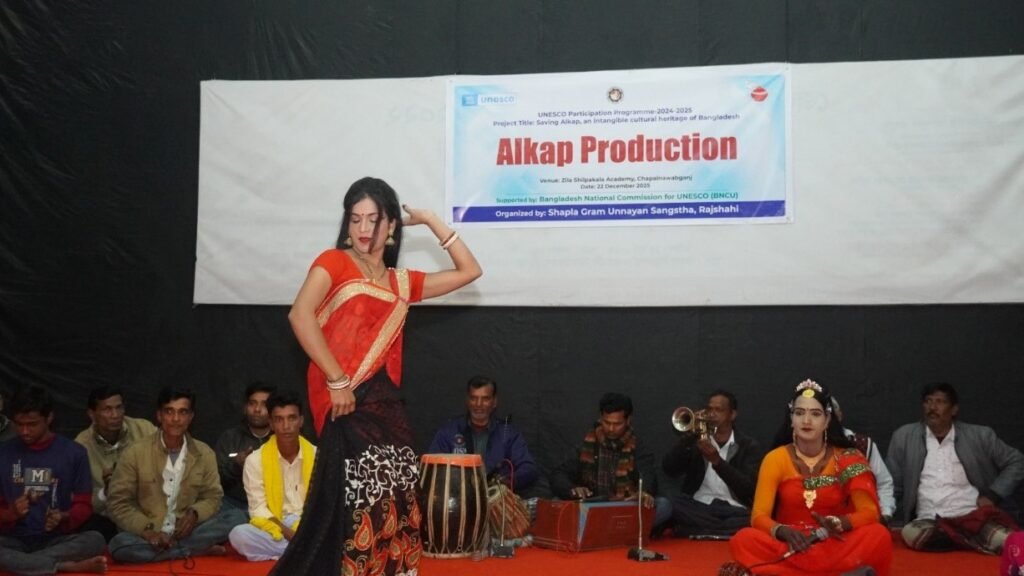
The performance specifically focused on raising awareness about drug addiction, the dangers of internet misuse and the unique lifestyle struggles of people living in drought-prone regions. By weaving these social messages into a traditional format, the event successfully demonstrated that Alkap remains a powerful tool for social commentary and community engagement.
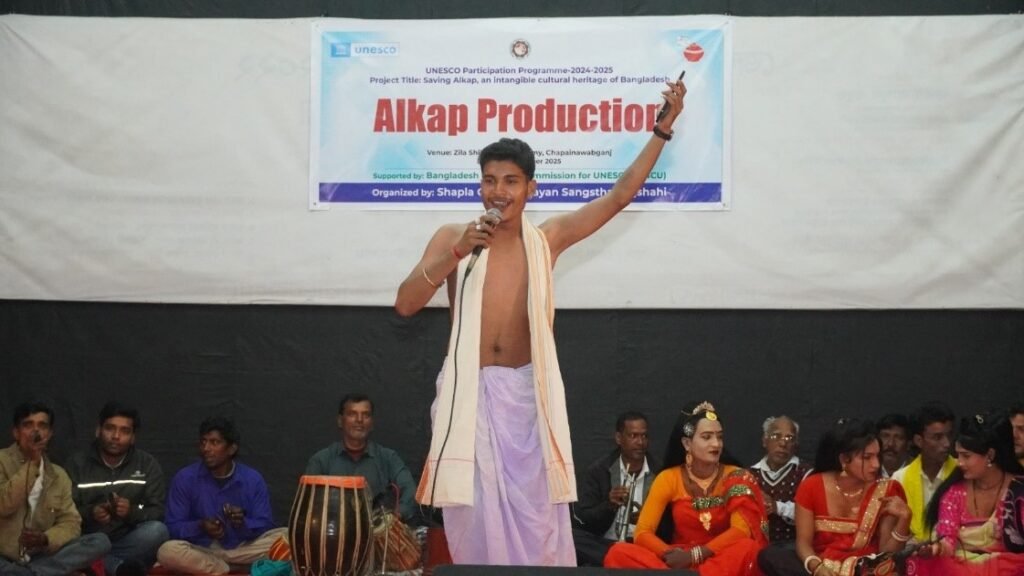
The event drew a diverse crowd, including cultural personalities, social workers, and folk music enthusiasts, who praised the initiative for reviving a sense of local identity. Spectators remarked that Alkap is not merely a source of entertainment but a deep-rooted reflection of their heritage that deserves recognition on the global stage.
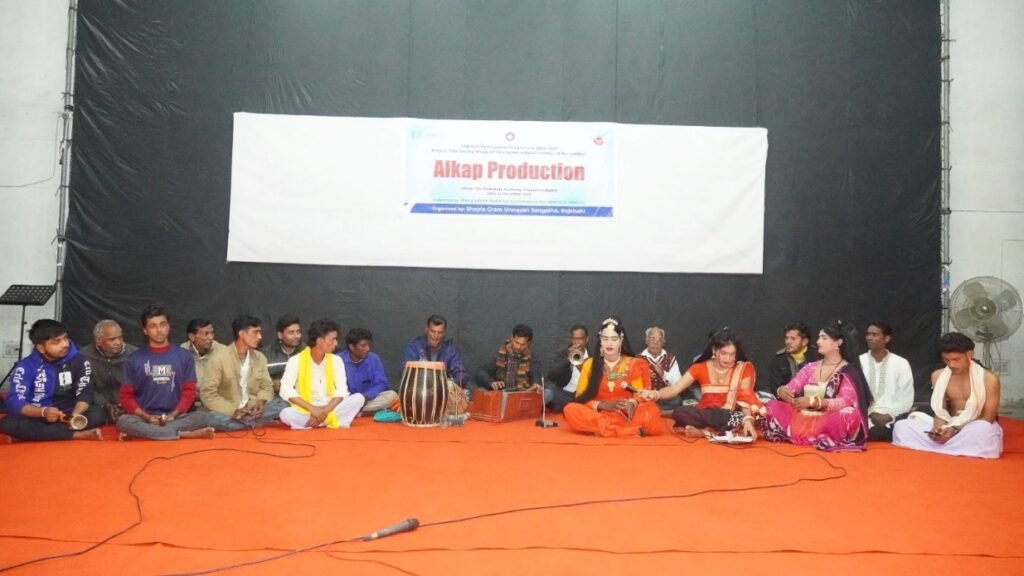
Representatives from Shapla Gram Unnayan Sangstha acknowledged that while preserving such intangible traditions is a significant challenge in the current era, the combination of UNESCO’s institutional support and the enthusiastic participation of the local community provides a promising path to bringing Alkap back into the mainstream cultural fabric of Bangladesh.
Alkap Production-2
Venue: Nimdighi Hat, Niamatpur, Naogaon
Date: 25 December 2025
The traditional folk performance known as `Alkap’, one of the most ancient and cherished cultural elements of the Rajshahi region, was recently showcased in a series of special productions aimed at rescuing the art form from the brink of extinction.
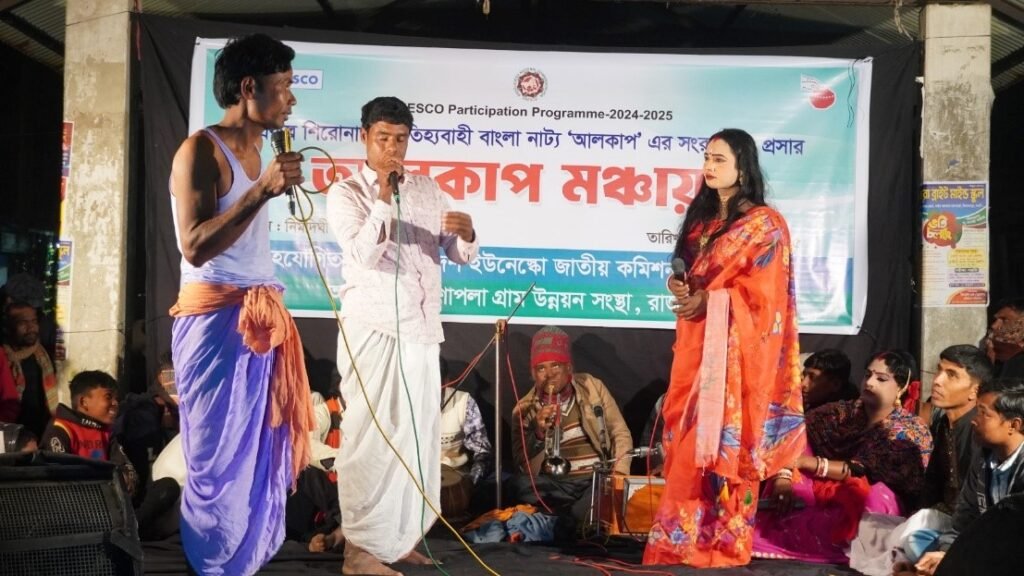
The initiative seeks to introduce this historic performing art to the younger generation and ensure its survival amidst modern cultural shifts.
Significant events in this project included a production on December 22, 2025, at the Zila Shilpakala Academy in Chapainawabganj, followed by another major showcase on December 25, 2025, at Nimdighi Haat in Niamatpur Upazila, Naogaon.
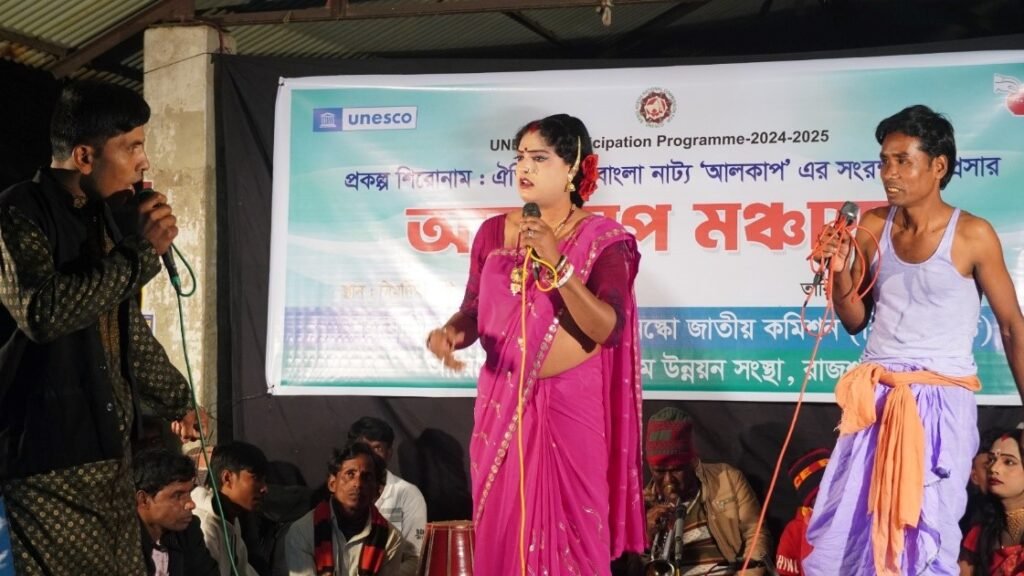
During these performances, local artists brought the endangered theatrical style to life by portraying various humorous and educational stories through rhythmic acting and music. Beyond simple entertainment, the Alkap productions serve a deeper purpose by fostering cultural awareness, strengthening local identity and acting as a platform for social commentary. The performances address critical social issues, promote communal harmony and provide economic opportunities for rural folk artists.
The collaboration with international bodies like UNESCO has provided these local performers with a rare opportunity to gain international visibility. By creating a space for veteran artists to mentor a new generation, this project is playing a vital role in transforming Alkap into a sustainable industry.
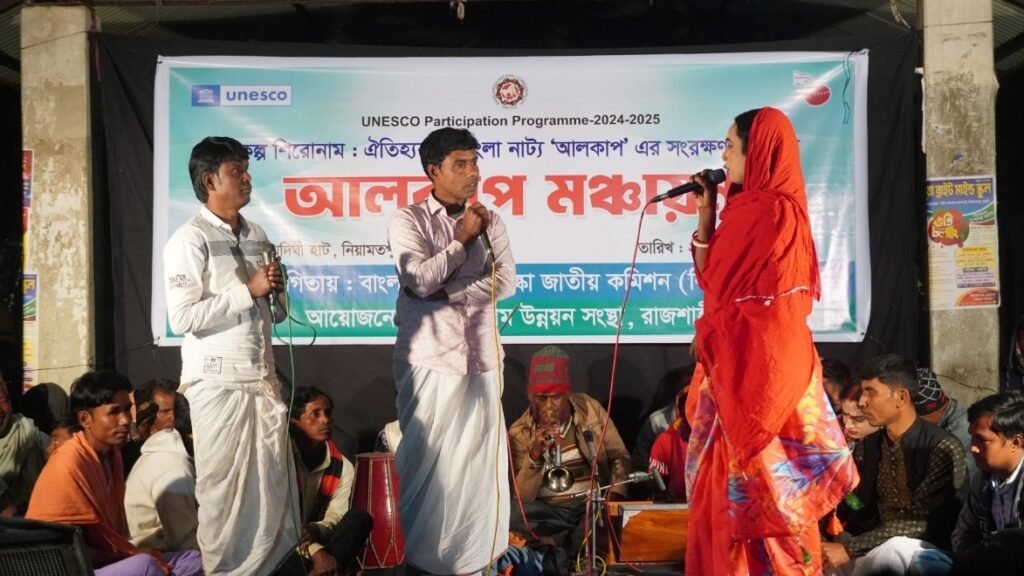
This strategic effort to document and perform traditional scripts ensures that the unique folk heritage of Northern Bangladesh remains a living, thriving part of the country’s cultural fabric for years to come.
Alkap Production-3
Venue: Lalon Shah Mukto Moncho, Rajshahi
Date: 29 December 2025
With a commitment to restoring the lost glory of Bengal’s folk culture and preserving traditional folk drama, a vibrant ‘Alkap Performance’ was held at the historic Lalon Shah Mukto Moncho on the banks of the Padma River in Rajshahi. Under the project titled “Preservation and Promotion of Traditional Bengali Folk Drama ‘Alkap’,” this event marked the third and final showcase of the series.
The program was graced by Mr. Muha. Tanjir Perves, Program Officer of the Bangladesh National Commission for UNESCO (BNCU), as the Chief Guest. Professor Dr. Ataur Rahman, a distinguished faculty member of the Department of Theatre at Rajshahi University, attended as a Special Guest and highlighted the artistic significance of the performance.
Also in attendance were Mr. Md. Mohsin Ali, Executive Director of Shapla Gram Unnayan Sangstha, and Dr. Md. Imrul Asad, Information and Research Officer.
As the Alkap session began in the open-air setting of the Lalon Shah Mukto Moncho after evening, a festive atmosphere swept through the venue. A large crowd, including general spectators and cultural enthusiasts, gathered to witness the sharp dialogues, wit, and musical rhythms of the folk artists. The audience was captivated by the traditional blend of social reform and entertainment unique to Alkap. In his speech, Professor Dr. Ataur Rahman remarked, “This timely initiative by Shapla Gram Unnayan Sangstha has instilled new hope in the hearts of culture lovers. In the digital age, as our root cultures are fading away, such live performances will inspire both artists and audiences alike.
This performance successfully fulfilled all the conditions of the project. Following two successful showcases earlier in Niamatpur, Naogaon, and Chapainawabganj district headquarters, this final show in Rajshahi served as a significant milestone. It is expected that the joint efforts of the international organization UNESCO and Shapla Gram Unnayan Sangstha will play a vital role in introducing the heritage of Alkap to the younger generation in the coming days. The event concluded amidst thunderous applause, leaving a lasting impact on Rajshahi’s cultural landscape.
Following the successful completion of the project, a comprehensive book has been prepared based on the entire project’s findings. The book is edited by the Project Officer, Dr. Md. Imrul Asad, with valuable guidance and consultations from professors of Rajshahi University and several other renowned educational institutions.
The book specifically covers the fundamental introduction to Alkap, its origin, evolution, and transformation, as well as performance techniques, stage craft, makeup, costumes and musical instruments. It also explores the potential of Alkap, concepts for its preservation and promotion, writings from prominent researchers, and essays published in various journals and books. Furthermore, it includes a list of current Alkap artists, relevant government listings, and a collection of photographs from all the organized events. This book, featuring such significant topics, will open new doors for future research on Alkap and serve as a vital resource for students. I believe this publication will be an invaluable addition to the field of cultural research in our country.
We would like to express our sincere gratitude to UNESCO, stating: We are committed to showcasing our folk culture to the global stage and ensuring its continued practice at the local level. The success of this project will encourage us to work on a larger scale in the future. Furthermore, I believe that by continuing to work jointly with UNESCO, we will be able to play an even more significant role in the cultural landscape of our country.